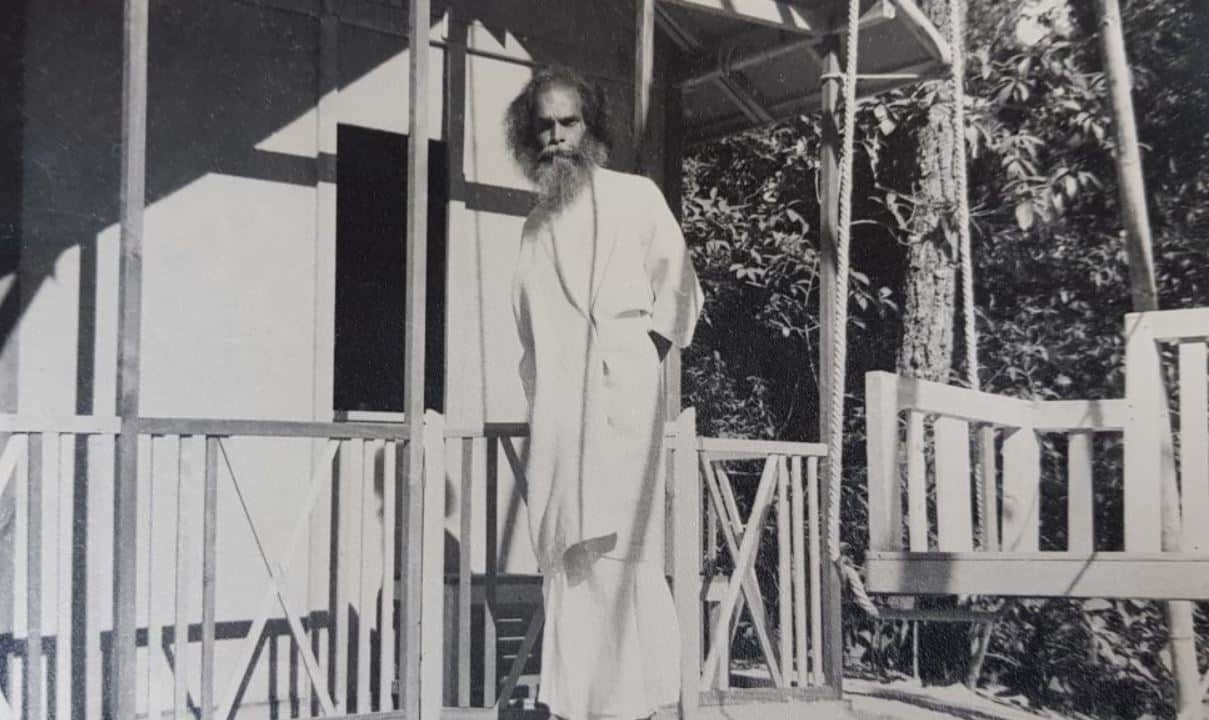
Right Living (Swadharma): The Teaching of Sri Shivapuri Baba
A first-hand account, drawn only from those who spoke with him
For the life of the man who taught it, see the biography.
The aim: an “Art of Living” that is also an “Art of Dying”
Everyone wants to be happy, the Baba taught, yet people suffer because they have learned neither how to live nor how to die. His answer was a single practical discipline he called the Right Life, or Swadharma — which he summarized to Radhakrishnan in 1956 as three disciplines, “spiritual, moral and physical,” and described elsewhere as the Bhagavad Gita brought up to date (Bennett and Manandhar 1965; Bennett 2016). It is not a religion of dogma or ritual but a method with a definite aim: to see the Truth, reach God, and so attain freedom (Singh 1984; Shrestha Malla, n.d.).
Two features make it universal. First, the Baba held that ordinary life is sustained not by pleasure or wealth, as people imagine, but by the three disciplines themselves, present in differing degrees in every creature (Singh 1984). Second, he insisted the path must be fitted to each person: the application of Swadharma differs from individual to individual, and conceptions of morality differ with time and place (Singh 1984). Hence his often-recorded saying — “Relatively speaking everybody is right; absolutely speaking everybody is wrong” (Singh 1984) — and Bennett’s observation that he framed the same teaching in the idiom of whoever came to him, telling one Christian disciple simply to hold his mind on Christ (Bennett 2016).
The problem: the threefold misery (Tribidha Tapas)
In the disciples’ systematization, human unhappiness springs from our own wrong living and from ignorance of what we are, which exposes us to a threefold misery (Shrestha Malla, n.d.). The three terms are taken from classical Sāṃkhya, where they denote suffering arising (a) from oneself, body and mind; (b) from other living beings and the external world; and (c) from cosmic or “divine” forces beyond our control. The compilers map these onto the three planes the disciplines are meant to heal — the physical/intellectual, the mental, and the spiritual — so that each discipline answers one layer of distress. The precise pairing is the disciples’ rendering and varies slightly between accounts; the constant is the diagnosis that suffering is rooted in ignorance and disorder, not in circumstance.
The cure: the three disciplines
1. Physical and intellectual discipline. Perform only your fixed and necessary duties (karma) — toward profession, family and society — done punctually and with dexterity; avoid useless activity (akarma) and harmful action (vikarma) (Singh 1984; Shrestha Malla, n.d.). Its fruit is a sound body, freedom from avoidable failure, and worldly pleasure (sukha) (Bennett and Manandhar 1965).
2. Moral and mental discipline. Free the mind from unlawful desire (icchā) and from the pull of likes (rāga) and dislikes (dveṣa), and cultivate the divine virtues — the daivī sampad of the Gita’s sixteenth chapter, traditionally counted as twenty-six, among them fearlessness, charity, truthfulness and self-control (Bennett and Manandhar 1965; Shrestha Malla, n.d.). Its fruit is a stable, untroubled mind and contentment / serenity (santoṣa) (Singh 1984; Shrestha Malla, n.d.).
3. Spiritual discipline. With body and mind ordered, turn the soul toward God: concentration (dhāraṇā), meditation (dhyāna), and above all spiritual enquiry — pressing the questions “Who am I?” and “What have I come here for?” (Bennett and Manandhar 1965; Shrestha Malla, n.d.). Its fruit is the removal of ignorance, freedom from fear, and peace (śānti) culminating in God-realization.
The Baba gave a vivid image for how the disciplines and the enquiry fit together: practising the three disciplines is like pulling the arrow out of the wound — it removes the immediate trouble — whereas the enquiry “Who am I?” leads back to the one who shot the arrow, that is, to God, the source (Shrestha Malla, n.d.). Bennett’s version is sparer still: reduce the practice to thinking of God alone, dismissing every other thought, until one sees God (Bennett and Manandhar 1965).
The two pillars: Discrimination (Viveka) and Devotion (Vairāgya)
Bennett records that the Baba grouped the physical and moral disciplines together as Discrimination (Viveka) and the spiritual discipline as Devotion (Vairāgya) — the two aspects of the Right Life — and held that someone who attends faithfully to the first two for about a decade becomes naturally able to fulfil the third (Bennett and Manandhar 1965). Singh preserves the Baba’s homely analogy for the three facets: observing the intellectual discipline is like paying your taxes, the moral discipline like obeying the country’s laws, and the spiritual discipline like passing the final examination for a high post (Singh 1984).
(One image in circulation — that Discrimination is “today’s meal” and Devotion “tomorrow’s meal” — fits the teaching but I could not confirm it in the first-hand sources consulted; Singh’s recorded analogy is the taxes/laws/examination one above. I flag it rather than present it as documented.)
Meditation and its stages
The Baba treated meditation as the heart of the spiritual discipline but was famously impatient with elaborate technique and austerity, which he regarded as distractions; he asked instead for a “minimum of life” lived fully and dutifully, without mortification (Bennett and Manandhar 1965). He distinguished the classical stages of concentration, meditation and absorption (dhāraṇā, dhyāna, samādhi), and — consistent with fitting the path to the person — let the object of contemplation follow each seeker’s own faith (Bennett 2016). What he stressed, the disciples agree, was practice over theory: the teaching is useless read, and only becomes real when done (Shrestha Malla, n.d.; Meares 1969).
Putting it into practice
The disciples preserve the Baba’s practical instructions across dozens of topical headings — among them duty, profession, food, suffering, satsang, charity, review, enquiry, struggle, grace and renunciation (Shrestha Malla, n.d.). The recurring practical counsel is:
- Keep a strict, punctual routine. Rise early, keep clean, discharge each duty on time, and reserve fixed periods for meditation and study; punctuality conserves energy and builds command over oneself (Shrestha Malla, n.d.).
- Review the day each night. Before sleep, look back impartially on the day, find where you failed in the physical, moral or spiritual discipline, and resolve to correct it tomorrow (Shrestha Malla, n.d.).
- Eat simply and purely. The disciples record a sāttvic diet and the setting-aside of tāmasic foods; the specific list (avoiding meat, fish, eggs and alcohol, favouring rice, pulses, milk and ghee) is their rendering of his counsel on food, which he tied to steadiness of mind (Shrestha Malla, n.d.). Meares, who met him in 1960, noted his abstemiousness directly (Meares 1969).
- Give in charity. Devote a portion of your earnings (the disciples specify about a tenth) to the poor, to learning, and to seekers; charity loosens attachment (Shrestha Malla, n.d.).
- Expect to struggle. The Baba did not demand quick success but sincere effort; one is to keep walking the path through failure and temptation, trusting that grace follows persistence (Shrestha Malla, n.d.; and cf. his personal promise to Bennett that realization would come to him before he died, Bennett and Manandhar 1965).
- Keep good company (satsang). Meet regularly with fellow seekers to speak openly of one’s shortcomings and receive guidance (Shrestha Malla, n.d.).
The experiential register: what the visitors were shown
Two outside witnesses recorded the teaching as it felt in conversation rather than as doctrine. Hugh Ripman’s travel diary preserves the Baba’s answer to why some people seek God and others do not — that most are simply drawn away by pleasure — and his teaching that the soul is the real “I,” which can never be explained but only experienced; he likened ordinary consciousness to fish living inside water, with God as what lies above the surface, so that to lift the head above the water, even for a moment, is to see God (Ripman 1999; quoted also in Singh 1984 and Shrestha Malla, n.d.). Dr. Ainslie Meares came away struck above all by the man’s serenity and by his insistence on practice over theory (Meares 1969).
The goal
The promise of the Right Life, in the disciples’ words, is the transformation of an ordinary person into Sat-cit-ānanda — Existence, Knowledge, Bliss — and release from the cycle of birth and death into lasting freedom and peace (Shrestha Malla, n.d.; Singh 1984). Singh, who set down his notes over more than a decade, called the teaching the Philosophia Perennis and was at pains to add that his book held only a small part of his conversations with his teacher (Singh 1984).
References
For where to find these works — in print, secondhand, or free to borrow online — see Books & Media.
- Bennett, J. G. 2016. The Shivapuri Baba and His Message: Four Lectures on a Great Indian Sage. The Collected Works of J. G. Bennett, vol. 11. Santa Fe, NM: Bennett Books. [Lectures delivered at Denison House, London, October–November 1962.]
- Bennett, J. G., and Thakur Lal Manandhar. 1965. Long Pilgrimage: The Life and Teaching of Sri Govindananda Bharati, Known as the Shivapuri Baba. London: Hodder & Stoughton.
- Meares, Ainslie. 1969. Strange Places, Simple Truths. London: Souvenir Press. [Chapter “Nepal,” recording his 1960 meeting.]
- Ripman, Hugh Brockwill. 1999. Search for Truth. Washington, DC: Forthway Center Palisades Press. [The “Travels and Conversations” section records his meeting with “a Hindu saint” — the Shivapuri Baba; his travel-diary dialogues are also quoted in Singh 1984 and Shrestha Malla, n.d.]
- Singh, Renu Lal. 1984. Right Life: Teachings of the Shivapuri Baba. Rev. and enl. ed. Ellingstring, North Yorkshire: Coombe Springs Press. (First published Kathmandu: Govinda Prasad Pradhan, 1975.) ISBN 0-900306-82-3.
- Shrestha Malla, Yogendra Bhakta (Y. B.). n.d. Right Living: The Teaching of Sri Shivapuri Baba (and his topically arranged compilation of the Baba’s sayings). Kathmandu: Ratna Pustak Bhandar.
- Timilsina, Bishnu Prasad. n.d. Swadharma. [In Nepali.]
Note on citation and method. Page numbers are deliberately omitted: supplying them would require collation against specific named print editions, and inventing them would defeat the purpose. Where a claim rests on a defined locus — the Radhakrishnan exchange in Long Pilgrimage, Ripman’s travel diary, Meares’s “Nepal” chapter — that locus is named in the text. Items marked “n.d.” are the two Nepali-disciple works whose publication years could not be fixed from the records consulted; they would benefit from verification against a library catalogue. Sāṃkhya terms are given in their standard transliteration; the Baba’s disciples spell several of them variously.
Source-critical caveat. The teaching itself is the most solid part of the Shivapuri Baba’s legacy, since it was recorded by several people who learned it directly from him and who broadly agree on its architecture. Two cautions remain. The reputed lifespan (137 years) and the pre-Nepal biography rest on his own testimony and are not part of the teaching’s evidentiary basis (these are weighed in the biography). And the scholastic detail — the enumerated miseries and virtues, the dietary and charitable specifics — is the Nepali disciples’ systematization of his oral answers; Bennett, who also heard him at length, deliberately rendered the same teaching far more plainly. Where the two registers diverge, this document marks which witness is speaking.