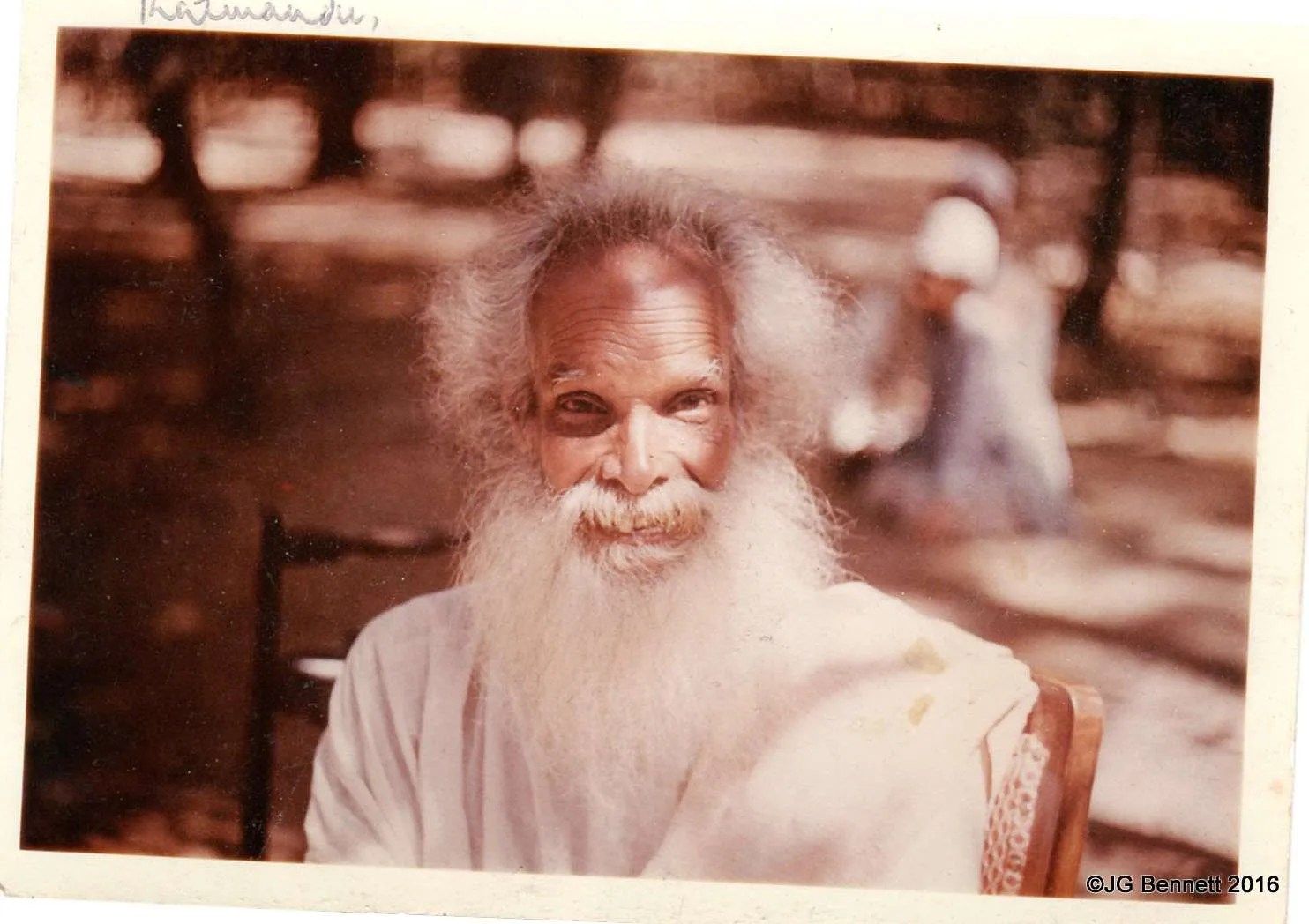
Shivapuri Baba (Sri Govindananda Bharati, 1826–1963)
A biography drawn only from first-hand sources — the records of people who actually met him (chiefly J. G. Bennett and Dr. Ainslie Meares) and the accounts of his disciples — with full source citations.
Scope and method. This account uses only material traceable to people who met Shivapuri Baba or recorded his words directly. Encyclopedic and popular-devotional retellings, the modern Kerala birthplace reconstruction, and external archival speculation have been excluded. “First-hand” here means as recorded by those who knew him — not independently documented. Almost the entire pre-Nepal narrative is the Baba’s own oral testimony as set down by Bennett, who accepted much of it on the Baba’s word. Citations follow an author–date style keyed to the References section; see the note there on the deliberate absence of page numbers.
How the record reached us
For decades nothing was written about the Baba; when he died in January 1963 he was known to only a small circle, and the first published account did not appear until 1965 (Bennett and Manandhar 1965). The surviving first-hand record rests on two independent Western eyewitnesses and a group of Nepali disciples.
J. G. Bennett — a British mathematician and seeker, earlier a pupil of Gurdjieff and Ouspensky — first heard of the Baba in the 1940s from Professor Ratnasuriya, a Buddhist scholar from Ceylon who had discussed him with Ouspensky, and later learned from his fellow Ouspensky pupil Hugh (Paul) Ripman, who had visited the Baba and recorded his impressions, that the yogi was still living (Bennett 1962). Bennett visited him at Kathmandu at Easter 1961 and again in 1962. He wrote about him in three places: the full biography Long Pilgrimage (Bennett and Manandhar 1965), written with the devotee Thakur Lal Manandhar; his own autobiography Witness: The Story of a Search (Bennett 1962), where the Baba stands among the formative teachers of his life alongside Gurdjieff, Ouspensky and Pak Subuh; and four public lectures delivered at Denison House, London, in October–November 1962, later published as The Shivapuri Baba and His Message (Bennett 2016). During the April 1962 interviews — at which his companions Marjorie von Harten and Melissa Marston were also present — Bennett made audio recordings of the Baba on 1–2 April, which survive in the J. G. Bennett Foundation archive (J. G. Bennett Foundation, n.d.).
Independently, and a year before Bennett, the Australian psychiatrist Dr. Ainslie Meares met the Baba in 1960 and devoted the “Nepal” chapter of Strange Places, Simple Truths to him (Meares 1969) — a valuable second eyewitness from entirely outside Bennett’s spiritual circle. The teaching itself was further preserved by Nepali disciples: Renu Lal Singh (1984), Y. B. Shrestha Malla (n.d.) and Bishnu Prasad Timilsina (n.d.).
Early life and renunciation (Bennett’s account)
By the account Bennett recorded, the man later known as Shivapuri Baba was born in 1826 into a wealthy, learned Brahmin family in South India, and took the renunciate name Govindananda Bharati on his initiation as a sannyasin (Bennett and Manandhar 1965). His grandfather, a respected astrologer, became his guru. As a young man he renounced his inheritance — transferring it to his sister — and followed his grandfather, who had entered the forest-hermit stage of life, into the forests at the source of the Narmada river in central India.
When the grandfather died (the Baba being then about twenty-five), he had reportedly foretold that his grandson would attain enlightenment in this life, drawn from him a promise to then make a pilgrimage on foot through India and around the world, and left him a small store of precious stones to fund it, since no one in the family had ever begged (Bennett and Manandhar 1965). Govindananda then withdrew into deep solitude in the Narmada forest for roughly twenty-five years, living on roots and wild fruit — so cut off, Bennett relates, that he learned of the 1857 uprising only long afterward. At about the age of fifty he attained the realization he sought, describing it as having come in a flash, after which every question was answered and every problem dissolved (Bennett and Manandhar 1965; Singh 1984).
The pilgrimage (from 1875)
Fulfilling his grandfather’s wish, Govindananda set out around 1875 on a journey that Bennett reckoned took about forty years and was made largely on foot (Bennett and Manandhar 1965). As Bennett sets down the route, he travelled westward through Afghanistan and Persia to Mecca and Jerusalem, through Turkey (with a long stay in Istanbul), across the Balkans, Greece, and Italy to Western Europe and England; then across the Atlantic to North America and Mexico, down through the Andes (Colombia and Peru, with his recollection of Lake Titicaca), across the Pacific by way of New Zealand and Australia to Japan, and home via China, Tibet, and Nepal — returning to his birthplace around 1915 to find his sister had died and the family property given away.
Bennett relates that the Baba spent about four years in England and, in that period, had a series of private audiences with Queen Victoria, who, grieving and preoccupied with questions of death, is said to have asked him not to leave the country during her lifetime (Bennett and Manandhar 1965). Bennett is candid that this is the least documented part of the story: the Baba, he writes, withheld most details of where he had been and whom he had met — answering, by Bennett’s own admission, no more than “a tithe of my questions” — and Bennett suspected that some of the apt stories the Baba told were embellished or even invented by him (Bennett and Manandhar 1965). The fuller roster of named meetings on the world tour (heads of state and famous contemporaries) appears not in Bennett but in the disciple Renu Lal Singh’s recollections, recorded from the Baba’s own oral telling decades later (Singh 1984); these therefore remain the Baba’s reported testimony at one remove, not independent documentation, and are not reproduced here.
The Nepal years
Around 1926, at the time of the Maha Shivaratri pilgrimage — when Nepal was effectively closed to outsiders — the Baba entered the Kathmandu valley, by tradition along the banks of the Bagmati (Bennett and Manandhar 1965; Shrestha Malla, n.d.). By the account Bennett and Manandhar give, he was recognized by an Englishman named Wilkinson, by then the British Resident in Nepal, whom he had encountered years earlier abroad, and who interceded with the Rana rulers to let the sage remain. He settled first on the forested ridge of Shivapuri north of Kathmandu — from which he took the name he became known by — and later moved to a hermitage at Dhrubasthali, in the forest behind the Pashupatinath temple. There he lived simply in a small wooden hut on a fenced compound, in part on the milk of a donated cow, visited by relatively few. The Rana government and, later, King Mahendra protected the ashram, posting guards from 1952. Disciples recalled that some three decades before his death he was found to have oral (gum) cancer and spent a period being treated in a hut at Kirateshwar; he is said to have left the retreat only once in these years, flying to Benares in 1955 — the single occasion he ever travelled by aeroplane (Singh 1984).
His most notable visitor of these years was Dr. Sarvepalli Radhakrishnan, who came to him on arriving in Kathmandu in 1956. Bennett records the exchange: asked what he taught, the Baba answered that he taught three disciplines — spiritual, moral, and physical; when Radhakrishnan marvelled that the whole truth could be put in so few words, he simply agreed that it could (Bennett and Manandhar 1965).
He died on 28 January 1963. Thakur Lal Manandhar, in the letter to Bennett reproduced in Long Pilgrimage, recorded that the Baba’s last instruction was to live the Right Life and worship God — nothing more — and that at dawn he rose, sat up, asked for a drink, said in Hindi that he was going (“Gaya”), lay down on his right side as he always did, and was gone (Bennett and Manandhar 1965). He was interred beneath a samadhi shrine at Dhrubasthali, which remains a place of pilgrimage and meditation.
What the eyewitnesses saw
The most striking feature of the surviving record is that two independent Western observers — a psychiatrist in 1960 and a former Gurdjieff pupil in 1961–62 — describe the same quality of presence.
Dr. Ainslie Meares came in 1960, when the Baba was reportedly 134, knowing nothing in advance of his age or reputation. What stayed with the psychiatrist was an “aura of serenity” unlike anything he could compare it to, deepening as they talked of life and death, of God and man. Pressing the question uppermost in his own mind, Meares asked whether pain ever troubled the old man; the Baba said it did not — yet, asked whether he felt pain at all, he answered that he did feel it, distinguishing the sensation of pain from being disturbed by it. Meares came away describing a man wholly unlike anyone he had met (Meares 1969).
Bennett, meeting him the next year at a reported 135, found him alert, quick, and graceful, with a phenomenal memory and a spiritual presence he found inspiring; in Long Pilgrimage he describes a man clear and concrete in his thinking, an enemy of speculation, eminently practical in his advice, and yet patient with everyone who came to him sincerely — a human being, as Bennett saw him, who had left the world’s struggles wholly behind (Bennett and Manandhar 1965). At the close of his second visit the Baba spoke to Bennett personally, telling him that he too would come to that Realization — to know God and be one with God — before he died, and promising it; Bennett wrote that such a conversation could not fail to affect him profoundly (Bennett and Manandhar 1965). The Baba also urged Bennett to give himself less to running organizations and more to his own meditation (Bennett 1962).
After the Baba’s death, an English disciple, Mrs. Nellie Hart, wrote to the Kathmandu devotee Karkat Man Tuladhar that the blessed radiance of his presence was not diminished by time (Singh 1984).
The teaching: the Right Life (Swadharma)
The Baba called his teaching the Right Life, or Swadharma, and described it as the Bhagavad Gita brought up to date (Bennett 2016; Singh 1984). Its core is three disciplines, or duties:
- a physical and social discipline — keeping body and mind in order through right livelihood and the faithful discharge of one’s obligations to family, society, government, and work; this, he taught, yields pleasure;
- a moral discipline — cultivating the virtues (truthfulness, self-control, fearlessness, charity, patience, freedom from anger) and remaining committed to truth throughout daily life; this yields serenity;
- a spiritual discipline — devotion to God, or the contemplation of Truth, to which all remaining time should be given; this yields peace.
The physical and moral disciplines together he called Discrimination (Viveka); the spiritual discipline he called Devotion (Vairagya) — the two aspects of the Right Life (Bennett and Manandhar 1965). He held that a person who attends faithfully to the first two duties for about a decade becomes naturally able to fulfil the third. Unusually among yogis, he was dismissive of elaborate techniques and austerities, which he saw as distractions, and insisted instead on a “minimum of life” lived fully and dutifully, without mortification. On meditation he reduced the practice to a single instruction: to think of God alone, dismissing every other thought, until one sees God (Bennett and Manandhar 1965; Shrestha Malla, n.d.; Timilsina, n.d.). Those who heard him noted that he framed this same teaching in the idiom of each questioner — a Hindu, Buddhist, Muslim, or Christian each hearing it in their own terms; one Christian disciple he told to hold the mind on the being of Christ (Bennett 2016).
For the teaching set out in full — the threefold misery, the three disciplines and their fruits, meditation, and the Baba’s practical counsel for daily life — see Right Living (Swadharma).
The circle who knew and recorded him
- J. G. Bennett (1897–1974) — visited 1961–62; author of Long Pilgrimage, of the Shivapuri Baba chapter of Witness, and of the four London lectures (The Shivapuri Baba and His Message); made the surviving 1962 voice recordings.
- Dr. Ainslie Meares (1910–1986) — Melbourne psychiatrist; met the Baba in 1960 and wrote of him at first hand in Strange Places, Simple Truths.
- Hugh (Paul) Ripman — visited the Baba and recorded his impressions; alerted Bennett that the Baba was still alive.
- Marjorie von Harten and Melissa Marston — present with Bennett at the recorded April 1962 interviews.
- Thakur Lal Manandhar — close Kathmandu devotee for more than thirty years, Bennett’s collaborator, keeper of the journals of the teaching, and author of the eyewitness account of the Baba’s death; his son Giridhar Lal Manandhar later republished Long Pilgrimage in Nepal.
- Renu Lal Singh — disciple; compiled the teachings and his conversations with the Baba as Right Life.
- Dr. Y. B. (Yogendra Bhakta) Shrestha Malla — disciple and collector of the Baba’s teachings; author of Right Living.
- Bishnu Prasad Timilsina — disciple; recorded the teaching in Nepali as Swadharma.
- Karkat Man Tuladhar and Madhav Prasad Timilsina (“Madhav Baje”) — devotees of the Nepal years; the latter cared for him over a long period.
- Mrs. Nellie Hart — English disciple who left a written remembrance after his death.
Caveats internal to the first-hand record
- “First-hand” is not the same as verified. The whole of the life before Nepal rests on the Baba’s own oral testimony as recorded by Bennett. Bennett accepted the 1826 birth — and so the reputed age of 137 at death — on the Baba’s word and on his own impression; he cited no records, and none exist. The two Western witnesses were even told slightly different ages for the same period: Meares 134 in 1960 (Meares 1969), Bennett 135 in 1961 (Bennett and Manandhar 1965).
- Bennett himself flagged the gaps. He acknowledged that the Baba answered only a small fraction of his questions about the long journey, and that some of the Baba’s anecdotes may have been embellished or invented by him (Bennett and Manandhar 1965). The route and named meetings of the travelling years therefore stand on a single, self-aware narrator and, for the fuller roster, on a disciple’s much later recollection (Singh 1984).
- Even the book’s authority was later qualified by the family. At the 2007 Kathmandu re-launch, Giridhar Lal Manandhar said he believed the Baba had never actually read Bennett’s manuscript, because at the end of his life he did not wish to engage with the world he was preparing to leave.
- What the eyewitnesses corroborate is character, not chronology. Meares and Bennett independently attest to the man’s serenity, clarity, and presence in 1960–62; none of the surviving first-hand witnesses can confirm the events of the nineteenth-century pilgrimage, which they knew only from the Baba’s own telling.
References
For where to find these works — in print, secondhand, or free to borrow online — see Books & Media.
- Bennett, J. G. 1962. Witness: The Story of a Search. London: Hodder & Stoughton. (Later editions: Tucson, AZ: Omen Press, 1974; Santa Fe, NM: Bennett Books.)
- Bennett, J. G. 2016. The Shivapuri Baba and His Message: Four Lectures on a Great Indian Sage. The Collected Works of J. G. Bennett, vol. 11. Santa Fe, NM: Bennett Books. [Four public lectures delivered at Denison House, London, October–November 1962.]
- Bennett, J. G., and Thakur Lal Manandhar. 1965. Long Pilgrimage: The Life and Teaching of Sri Govindananda Bharati, Known as the Shivapuri Baba. London: Hodder & Stoughton. (Later editions include a 2001 Kathmandu edition prepared by Giridhar Lal Manandhar and a 2016 reprint, ISBN 978-1-5306-2431-7.)
- J. G. Bennett Foundation. n.d. “The Shivapuri Baba Interviews.” Audio recordings made in Kathmandu, 1–2 April 1962. Accessed 17 June 2026. https://www.jgbennett.org/product/shivapuri-baba-interviews/.
- Meares, Ainslie. 1969. Strange Places, Simple Truths. London: Souvenir Press. [The chapter “Nepal” records his 1960 meeting with the Shivapuri Baba.]
- Singh, Renu Lal. 1984. Right Life: Teachings of the Shivapuri Baba. Rev. and enl. ed. Ellingstring, North Yorkshire: Coombe Springs Press. (First published Kathmandu: Govinda Prasad Pradhan, 1975.) ISBN 0-900306-82-3.
- Shrestha Malla, Yogendra Bhakta (Y. B.). n.d. Right Living: The Teaching of Sri Shivapuri Baba. Kathmandu: Ratna Pustak Bhandar.
- Timilsina, Bishnu Prasad. n.d. Swadharma. [In Nepali.]
Note on citation and method. Citations are given by author and date and keyed to the entries above; where two works by Bennett share a year, the entries are distinguished by title. Page-level references are deliberately not supplied: they would require collation against specific named print editions, and inventing them would be the opposite of rigour. Where a claim rests on a defined locus within a source — Manandhar’s letter and the Radhakrishnan exchange in Long Pilgrimage, or the “Nepal” chapter of Meares — that locus is named in the text. Dates marked “n.d.” reflect editions whose year of publication could not be established with confidence from the records consulted; the two Nepali-disciple compilations (Shrestha Malla; Timilsina) are the least firmly dated and would benefit from verification against library catalogue records.